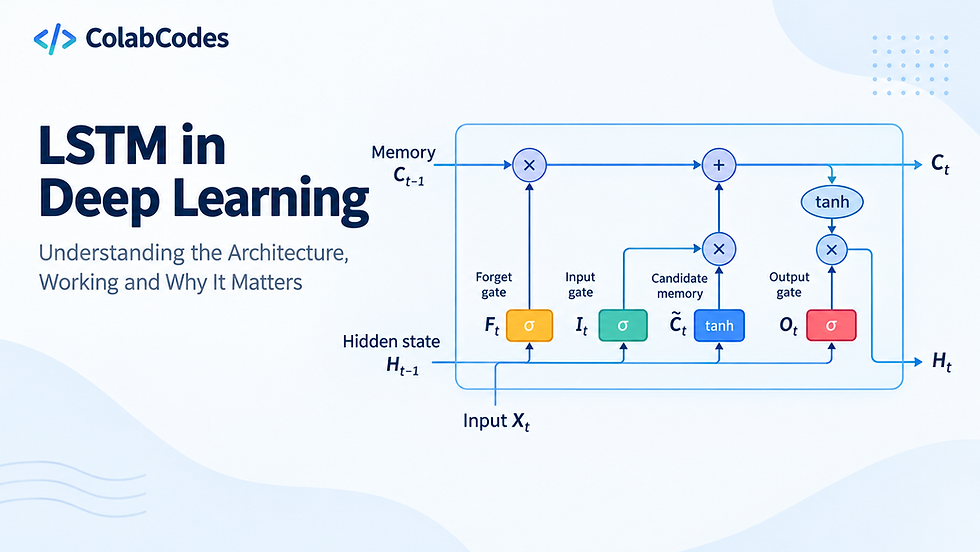

Diffusion Models in Generative AI: Concepts, Process, and Applications
Updated: May 7
Diffusion models have quickly become one of the most important breakthroughs in modern artificial intelligence, especially in the field of generative modeling. From creating hyper-realistic images to powering advanced tools like AI art generators, diffusion-based approaches are redefining how machines understand and generate complex data. Their rise is closely tied to the growing demand for high-quality content generation across industries such as design, entertainment, healthcare, and marketing.
This blog explores the fundamentals of diffusion models, including how they work, the intuition behind noise-based learning, and their role in modern AI systems. Key components such as the forward and reverse diffusion process and types of approaches to diffusion based models is covered.

What Are Diffusion Models in Generative AI?
Diffusion models are a type of generative AI model designed to create new data, most commonly images, by learning how to turn randomness into structure. Instead of producing an output in a single pass, these models work through a gradual refinement process. They start with noise and repeatedly clean it up until a coherent image emerges.
At their core, diffusion-based neural networks are trained using deep learning to simulate a two-phase process. First, they learn how data gets corrupted by noise over time. Then, they learn how to reverse that corruption step by step. This ability to reconstruct meaningful patterns from pure noise is what allows them to generate highly detailed and realistic outputs.
In recent years, diffusion models have taken center stage in generative AI. They power widely known systems such as Stable Diffusion, DALL·E, Midjourney, and Imagen. Compared to earlier approaches like Variational Autoencoders (VAEs), Generative Adversarial Networks, and autoregressive models such as PixelCNN, diffusion models tend to produce more stable training behavior and higher-quality result.
The underlying idea borrows intuition from physical diffusion processes. Imagine a drop of ink slowly spreading in water. Over time, the structure disappears into randomness. Diffusion models learn this exact transformation in a digital sense by gradually adding noise to images until they resemble static. Once that forward process is understood, the model learns to reverse it, effectively reconstructing images by removing noise in small, controlled steps.
While they are best known for image generation tasks like creating artwork, enhancing resolution, or filling in missing parts of an image, diffusion models are not limited to visuals. Their use cases now extend into areas such as audio synthesis, molecular design, and drug discovery. That said, most practical discussions focus on image generation since that’s where their impact is most visible and easiest to show off.
Different Approaches to Diffusion Models in Generative AI
Diffusion models have evolved into a diverse set of architectural variants, each carefully designed to balance output quality, computational efficiency, and sampling speed. While the core principle remains consistent, learning to reverse a gradual noising process, the way different models represent, optimize, and traverse this process varies significantly across implementations.
Understanding these different types of diffusion models is essential for grasping how modern generative AI systems achieve both high performance and flexibility. Each variant represents a trade-off between speed, control, and fidelity, collectively forming the backbone of today’s most advanced generative technologies.
1. Denoising Diffusion Probabilistic Models (DDPMs)
Denoising Diffusion Probabilistic Models (DDPMs) represent a significant leap in generative AI, providing a stable alternative to Generative Adversarial Networks (GANs). By framing generation as a systematic "cleanup" of noise, these models achieve high-quality results across images, audio, and video.
The Forward Diffusion Process: Systematic Corruption
The forward process is a fixed, non-trainable Markov chain. It begins with a clean data sample (e.g., a photograph) and gradually adds Gaussian noise over T timesteps.
At each step t, the data xt is derived from xt-1 using a variance schedule βt:

The term I is an identity matrix. Therefore, the distribution at each time step is called Isotropic Gaussian. As t approaches T, the original structure is obliterated, leaving only a distribution that is indistinguishable from isotropic Gaussian noise. This provides the "training data" for the reverse process.
The Reverse Diffusion Process: Generative Reconstruction
The core of a DDPM is the Reverse Diffusion Process. Since we cannot easily invert the forward noise addition, we train a neural network (typically a U-Net) to approximate these transitions.
The model learns to predict the distribution pθ ( xt−1| xt ). In practice, rather than predicting the entire previous image, the network is optimized to predict the noise component added at that specific timestep.
The Optimization Objective
Training is simplified by minimizing the Mean Squared Error (MSE) between the actual noise added (ϵ) and the noise predicted by the model (ϵθ):

This optimization objective trains the model to predict the exact noise added to data at a given timestep. A noisy sample xt is created by adding Gaussian noise ϵ to the original data x0, and the model ϵθ tries to estimate that noise.
Minimizing this loss forces the model to learn how to remove noise step by step, which is what ultimately enables it to generate clean data from pure noise.
αt is a parameter in the diffusion process that controls how much of the original data is retained at timestep t, with the remaining portion replaced by noise. It is part of the noise schedule, typically defined as αt = 1 − βt where βt determines the amount of noise added.
To address the speed bottleneck, modern iterations like DDIMs (Denoising Diffusion Implicit Models) and Latent Diffusion Models (LDMs) have been developed. These variants allow for faster sampling by skipping timesteps or operating in a compressed mathematical space, respectively.
2. Denoising Diffusion Implicit Models (DDIMs)
Denoising Diffusion Implicit Models (DDIMs) build directly on the foundation of DDPMs but introduce a more efficient approach to the reverse diffusion process. Importantly, the forward process remains unchanged, where Gaussian noise is gradually added to data over a sequence of timesteps using a fixed variance schedule. This ensures that DDIMs operate within the same probabilistic framework and training setup as standard diffusion models.
The key innovation in DDIMs lies in how the reverse process is handled. Unlike DDPMs, which rely on a fully stochastic Markov chain and require sampling noise at every step, DDIMs define a deterministic or partially deterministic mapping for reversing the diffusion. By predicting the original clean sample from a noisy input and directly computing earlier states, DDIMs eliminate the need for additional randomness during sampling.
This modification allows DDIMs to follow a non-Markovian trajectory, enabling the model to skip multiple timesteps during inference. As a result, high-quality outputs can be generated with significantly fewer steps, reducing computational cost and improving sampling speed. This efficiency makes DDIMs particularly well-suited for real-world generative AI applications where latency and scalability are critical.
3. Latent Diffusion Models (LDMs)
Latent Diffusion Models (LDMs) take the diffusion framework and apply a much-needed reality check to its computational cost. Instead of performing diffusion directly in high-dimensional pixel space, LDMs first map input data into a lower-dimensional latent representation using an encoder. This compressed space preserves the essential structure and semantics of the data while significantly reducing the dimensionality, making the diffusion process far more efficient.
Formally, an input sample x is encoded into a latent vector z using an encoder network, and the diffusion process is applied in this latent space rather than on raw pixels:
The forward diffusion process then operates on z, following the same noise addition mechanism used in standard diffusion models:
During generation, the model learns to reverse this process in latent space by predicting and removing noise step by step. Once a clean latent representation is obtained, it is mapped back to the data space using a decoder:
By shifting diffusion into a compressed latent domain, LDMs drastically reduce memory usage and computational requirements while maintaining high-quality outputs. This design enables scalable training and faster inference, which is why models like Stable Diffusion rely on this approach to generate high-resolution images efficiently.
4. Score-Based Generative Models
Score-Based Generative Models offer a sophisticated mathematical framework that generalizes the concepts found in standard diffusion models. While traditional diffusion focuses on learning reverse transition probabilities, SGMs focus on the score function: the gradient of the log-probability density of the data distribution.
In essence, the model learns a vector field that points toward regions of higher data density. By following these gradients, the model can iteratively "push" noisy samples back toward the original data manifold.
The Continuous-Time Framework: SDEs
One of the primary advantages of score-based modeling is the transition from discrete timesteps to continuous time. This is achieved using a Stochastic Differential Equation (SDE) to define the forward noise process:

In this formulation:
1. f(x, t) represents the drift coefficient, which governs the deterministic change in the data.
2. g(t) is the diffusion coefficient, controlling the amount of noise injected at time t.
3. dw denotes the Wiener process (standard Brownian motion).
As t increases, this SDE systematically transforms a complex data distribution into a known, simple noise distribution (typically Gaussian).
Reverse-Time SDE and Sample Generation
To generate new data, we solve the reverse-time SDE. This process relies on the learned score function ∇x log pt(x) to guide the denoising trajectory. The reverse process is defined as:

By simulating this reverse SDE, the model starts with pure noise and follows the gradient of the log-density to reconstruct meaningful samples. This approach unifies various generative techniques under a single theoretical umbrella, providing greater flexibility in sampling speeds and strategies.
5. Conditional Diffusion Models
Conditional diffusion models extend the standard framework by incorporating additional information such as text descriptions, class labels, or semantic maps. This conditioning guides the generation process, enabling more controlled and targeted outputs.
Text-to-image systems like DALL·E and Imagen rely heavily on conditional diffusion to align generated images with textual prompts. Conditioning is typically implemented through cross-attention mechanisms within the neural network architecture.
This capability is the backbone of modern AI applications like text-to-image generation (e.g., Stable Diffusion) and image-to-image translation.
In a standard diffusion model, the denoising network predicts the noise added to an image based only on the current noisy sample xt and the timestep t. In a conditional model, we provide an extra input y (the condition), modifying the network to learn p( xt-1 | xt , y ).
There are two primary methods for implementing this guidance:
1. Classifier Guidance
This technique uses a separate, pre-trained classifier to steer the diffusion process. During the reverse sampling stage, the gradient of the classifier’s output with respect to the noisy image is used to "nudge" the sample toward the desired class.
Pros: Highly effective for categorical labels.
Cons: Requires an extra classifier trained on noisy data, which can be computationally expensive.
2. Classifier-Free Guidance (CFG)
CFG has become the industry standard because it doesn't require an external classifier. Instead, a single model is trained for both conditional and unconditional generation. During sampling, the model performs two passes: one with the condition y and one with a null condition ∅.
The final output is a linear combination of these two predictions:

Here, s is the guidance scale. A higher scale forces the model to adhere more strictly to the prompt, often at the cost of some visual diversity.
Each of these diffusion model variants represents a trade-off between speed, control, and output quality. DDPMs prioritize fidelity, DDIMs optimize sampling efficiency, latent diffusion reduces computational cost, score-based models strengthen theoretical grounding, and conditional models enable real-world usability. Together, they form the backbone of modern generative AI systems that continue to push the limits of synthetic data generation.
Role of Attention Mechanisms in Diffusion Models
Modern diffusion models, particularly latent diffusion architectures such as Stable Diffusion, incorporate attention mechanisms to improve semantic understanding and prompt alignment during image generation.
While convolutional layers in diffusion models capture local spatial patterns, attention layers help the model learn long-range relationships across different regions of an image. This allows generated outputs to maintain global consistency, object coherence, and detailed structural relationships.
One of the most important forms used in text-to-image diffusion systems is cross-attention. In this mechanism, textual embeddings generated from the input prompt interact with latent image representations during the denoising process. The model learns to associate specific words or phrases with relevant visual regions and semantic features within the generated image.
For example, in a prompt such as “a futuristic city with neon lights and flying cars,” cross-attention helps the model align concepts like “neon lights” and “flying cars” with corresponding visual structures during image synthesis.
Attention mechanisms have therefore become a critical component of modern generative AI systems, enabling diffusion models to generate more contextually accurate and semantically aligned outputs.
Applications of Diffusion Models
Diffusion models have become one of the most significant advancements in generative artificial intelligence due to their ability to generate highly realistic and semantically meaningful data. By learning to gradually reverse noise corruption through iterative denoising, these models can synthesize images, audio, video, and other complex data distributions with remarkable quality and consistency. Their probabilistic nature allows them to model intricate patterns while maintaining diversity in generated outputs.
The rapid adoption of diffusion-based architectures in modern AI systems has transformed industries ranging from digital media and entertainment to healthcare and scientific research. Models such as Stable Diffusion have demonstrated how diffusion techniques can generate high-quality visual content from natural language prompts, while newer architectures continue to expand their applications into multimodal and real-time generative systems.
Some of the major applications of diffusion models include:
Text-to-Image Generation: Generating realistic and prompt-conditioned images for digital art, advertising, game design, and creative content generation.
Image Inpainting and Editing: Reconstructing missing image regions, removing objects, enhancing image quality, and performing style transfer operations.
Video Generation: Synthesizing realistic video sequences, animations, and cinematic scene transitions using temporal diffusion modeling.
Audio and Speech Synthesis: Producing natural-sounding speech, music generation, and high-fidelity audio restoration through diffusion-based waveform generation.
Medical and Scientific Research: Supporting medical imaging, molecular generation, protein structure modeling, and drug discovery applications.
Multimodal AI Systems: Integrating with transformers, attention mechanisms, and language models to power advanced AI assistants and interactive generative systems.
As diffusion architectures continue to evolve, they are increasingly being combined with transformer-based attention mechanisms, latent representations, and large-scale multimodal learning frameworks. This combination has positioned diffusion models as a foundational component of modern generative AI research and real-world AI applications.
Conclusion
Diffusion models have redefined the landscape of generative AI by shifting the focus from direct generation to iterative refinement. By learning how to transform noise into structured data, these models achieve a level of stability and output quality that earlier approaches struggled to maintain. From foundational frameworks like DDPMs to efficient variants such as DDIMs and scalable approaches like latent diffusion, each evolution addresses key limitations while pushing performance further.
The introduction of score-based methods and conditional diffusion has expanded their capabilities beyond simple generation, enabling controlled, high-fidelity outputs aligned with real-world requirements. This adaptability is what makes diffusion models central to modern applications, from image synthesis to scientific research and beyond.
As research continues to improve sampling efficiency and reduce computational cost, diffusion models are expected to play an even larger role in shaping the future of AI-driven content generation. They are no longer just experimental models but a core technology driving the next generation of intelligent systems.